COMPREHENSIVE SUSTAINABLE MOBILITY PLAN FOR COMPANIES
IDEA offers you the know-how and tools that are necessary to develop an alternative and customised mobility plan for the complete renewal of a fleet of combustion engine vehicles.
study
Consumption study
Benefits
All advantages and benefits
Development
your electric mobility plan....
Did you know...?
All about the electric vehicle...
A comprehensive study of your electric mobility plan
We guide you towards environmentally friendly and clean mobility
Installation of power lines to supply new chargers.
Study of nearby charging points.
Connection point to the network.
Advantages and Benefits of a Sustainable Electric Mobility Plan
We develop an advanced study of your needs and design solutions to integrate sustainable mobility into your company or business.
We help you to raise awareness in the use of electric vehicles and the necessary logistics for their efficient use, as well as to know the advantages and benefits, both in terms of costs and emission savings, which are achieved by means of a sustainable mobility plan in line with the 21st century.
Our service has a comprehensive approach, involving companies, employees, clients and suppliers.
¿What are the benefits and advantages of a sustainable mobility plan for my company?
Determination of the scope, general objectives, team and corporate commitment.
Phase 2
Diagnosis
Identification and analysis of the infrastructure and mobility habits of the company and its employees.
Phase 3
Development of the strategy and action plan.
Delimitation of vision, objectives and key points of the strategy to continue with the development of the company’s action plan.
Phase 4
Implementation.
Implementation of the company’s electric mobility strategy and action plan.
Phase 5
Monitoring and assessment.
Monitoring of the action plan to compare results and assess achievements and improvements.
Phase 1
Preliminary analysis
Determination of the scope, general objectives, team and corporate commitment.
Phase 2
Diagnosis
Identification and analysis of the infrastructure and mobility habits of the company and its employees.
Phase 3
Development of the strategy and action plan.
Delimitation of vision, objectives and key points of the strategy to continue with the development of the company’s action plan.
Phase 4
Implementation.
Implementation of the company’s electric mobility strategy and action plan.
Phase 5
Monitoring and assessment.
Monitoring of the action plan to compare results and assess achievements and improvements.
Everything you should know about electric vehicles.
There is a wide offer of cars whose propulsion is based on a rechargeable electric battery with longer battery life in terms of travel time, charging times and, most importantly, zero emissions in mobility.
The electric car is a reality.
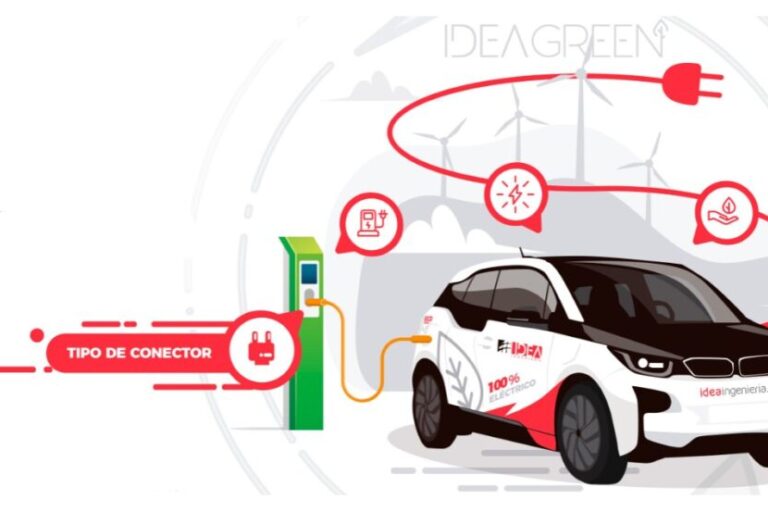
Electric vehicle charging facilities must be designed according to specific needs and depending on the type of vehicle and its intended use. The facility type depends on charging modes and connectors.
Types of connectors in electric vehicles
Schuko
They are used for charging modes 1 and 2. These are conventional connectors, so their use is recommended for small vehicles (scooters and/or electric bikes).
Type 1 (Yazaki)
Type 1 chargers (Yazaki) are standardised for Asia and Europe, respectively, for use in charging mode 3. These connectors are suitable for charging in single-phase and three-phase alternating current, enabling semi-fast charging, around 3-5 h.
Type 2 (Mennekes)
Type 2 (Mennekes) chargers are also standardised for Asia and Europe, respectively, for use in charging mode 3. These connectors are suitable for charging in single-phase and three-phase alternating current, enabling semi-fast charging, around 3-5 h.
Combo 2
They are suitable for the same charging modes as type 1 and 2 connectors, as well as VDC charging with the two pins at the bottom, offering ultra-fast charging (less than 1 h).
Chademo
An alternative to COMBO. The difference lies in the pins. Its ultra-fast direct current charging can provide between 50-350 kW of power.
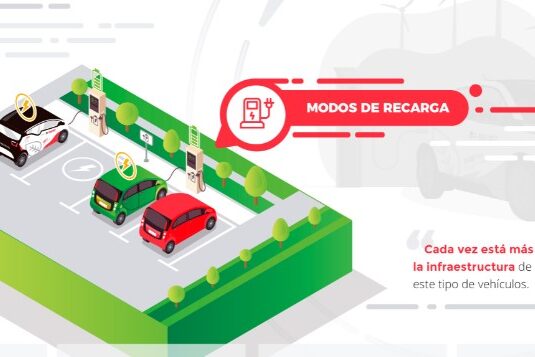
Charging modes for electric vehicles
MODE 1
Schuko Conector SLOW CHARGING (6-8H)
Specific Connector for E.V: No
Charging type: Slow, AC (single-phase or three-phase)
Max current:: 16A/phase (3.7kW- 11kW)
Protections: differential + magnetothermic
Special Features: Schuko socket with adapter.
MODE 2
Schuko Conector SLOW CHARGING (6-8H)
Specific Connector for E.V: No
Charging type: Slow, AC (single-phase or three-phase)
Max current: 32A/phase (3,7kW- 11kW)
Protections: differential + circuit breaker
Special features: special cable with an intermediate electronic device with pilot control function and protections.
MODE 3
SAVE o Wallbox SEMI-FAST CHARGING (3-4H)
Specific Connector for E.V: Yes
Charging type: Slow or semi-fast (single-phase or three-phase)
Max current: Depending on the connector used (up to 43kW in three-phase connection).
Protections: Included in the special infrastructure for charging the E.V.
Special features: Connection via EVSE.
MODE 4
VSAVE (COMBO O CHADEMO) FAST CHARGING (<45 MIN)
Specific Connector for E.V: Yes
Charging type: Fast-ultra fast
Max current: Depending on the connector used, 50kW minimum (up to powers of 350kW or higher).
Protections: Included in the special infrastructure for charging the E.V.
Special features: Use of an EVSE that includes a fixed external charger and an AC-DC converter.
Live development of the charging infrastructure, as well as the improvement in battery technology to achieve a longer battery life and shorter charging times, make the electric vehicle into a fully viable and necessary alternative.
Charging stations, also known as individual charging points or electronic charging stations, are a growing reality that switched from a mere imagination for the “near future” to a reality of the present.
The International Energy Agency (IEA) estimates that, by 2025, there will be around 50 million electric vehicles on the roads, in comparison to the 2.5 million vehicles that exist nowadays. This number will rise to 300 million by 2040.
Regarding the benefits of the Plan for purchasing a car, if it’s a 100% electric car, a refund of up to 7,000 euros will be granted and, if it’s a plug-in-hybrid car, up to 5,000 euros may be refunded”.
The largest amount of the financial aids will be allocated to electric commercial vehicles. In this case, they must have a battery life of more than 30 kilometres. If a vehicle older than seven years old is scrapped, the financial aid amounts to 9,000 euros, which is otherwise reduced to 7,000 euros. No maximum transaction price is specified in this case.
The new Moves Plan grants a subsidy of up to 80% of the necessary outlay if the charger is installed in towns of less than 5,000 inhabitants; and a subsidy of up to 70% of the amount for individuals and self-employed people.
In the case of public fast chargers (15 minutes for full charging), the financial aids granted will be divided in: 55% to small companies, 45% to medium-sized companies and 35% to large companies. In these cases, the financial aid increases by five points in municipalities with less than 5,000 inhabitants.
In terms of R&D&I, the largest amount of this budget, a total of 415 million euros, was allocated for research and development to speed up the sustainable development of the automotive sector.
An approximate amount of 100 million euros will be allocated exclusively to public procurement of mobility infrastructure innovation, reinforcing charging possibilities and locations.
The most interesting item for drivers is one that allocates an aid of 200 million euros for purchasing electric vehicles, 100 million euros for purchasing efficient vehicles and 100 million for the renewal of vehicles
Contact Us
You may use the contact form at the bottom and email us. And of course, you can call us by phone at (+34) 968 500 805 , and we will resolve any enquiries.
IDEA utiliza cookies propias y de terceros para analizar tus hábitos de navegación, obtener información estadística y mostrarte contenidos relacionados.
Funcional
Always active
El almacenamiento o acceso técnico es estrictamente necesario para el propósito legítimo de permitir el uso de un servicio específico explícitamente solicitado por el abonado o usuario, o con el único propósito de llevar a cabo la transmisión de una comunicación a través de una red de comunicaciones electrónicas.
Preferencias
El almacenamiento o acceso técnico es necesario para la finalidad legítima de almacenar preferencias no solicitadas por el abonado o usuario.
Estadísticas
El almacenamiento o acceso técnico que es utilizado exclusivamente con fines estadísticos.El almacenamiento o acceso técnico que se utiliza exclusivamente con fines estadísticos anónimos. Sin un requerimiento, el cumplimiento voluntario por parte de tu Proveedor de servicios de Internet, o los registros adicionales de un tercero, la información almacenada o recuperada sólo para este propósito no se puede utilizar para identificarte.
Marketing
El almacenamiento o acceso técnico es necesario para crear perfiles de usuario para enviar publicidad, o para rastrear al usuario en una web o en varias web con fines de marketing similares.